


Underground, the rise began
Header image: © Emser Bergbaumuseum

Mining in Bad Ems
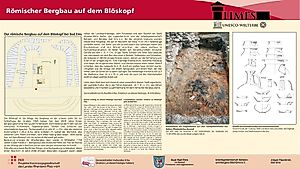
You'd hardly guess it, but the fashionable spa town had a very different face in the west. For centuries, mining shaped the Emsbach valley too. The Romans probably searched for silver on the Blöskopf in the 1st century. Mining enjoyed its first heyday in the Middle Ages. In 1158 Emperor Frederick Barbarossa granted the Emser silver mines to the Archbishop of Trier. By then, work was already under way in several tunnels and shafts. After a long interruption, mining resumed in the 18th century. It was always an important source of income for the people of Ems as well. While the skilled workers mostly came from elsewhere, locals could find work as day labourers and in transport.

From a day out to an industrial district
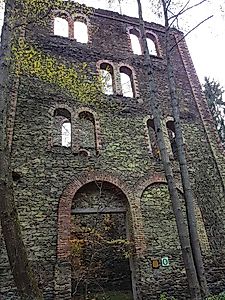
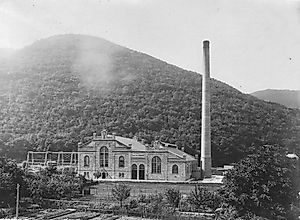
Mining reached its greatest heyday in the second half of the 19th century, during the age of industrialisation. Until around 1860, the still small smelting works was a destination for spa guests, who could watch the spectacle of the “Silberblick” (silver flash), the moment during the smelting of lead ores when the silver separated out. But then the production plants grew ever larger, and the idyllic Emser Hütte became an industrial district with extensive works, chimneys, spoil heaps and, in 1866, a works school, today's Ernst-Born-Schule. Around 1880, about 200 families with over 1,000 people lived in the company housing. A large processing plant was built on Silberau island. A works railway connected the production sites. To pump water out of the ever deeper tunnels and shafts, a first steam engine was put into service in 1858, followed by others. In 1903, the Emser Blei- und Silberwerk built a large power station in the Lindenbach, which used two powerful steam engines to generate electricity for the pumps throughout the vast network of mine workings. Today the imposing building is a monument to industrial architecture.

Hard work underground
Ore production kept rising in the 19th century and reached a peak in 1880 at 109,000 tonnes. At that time 1,600 people worked at the mine, the smelting works and the processing plant. The miners had regular working hours, comparatively good pay and, for the time, relatively good social security. Their lives, however, were marked by hard and dangerous work. The dust created when breaking out the rock settled in the lungs over the years and often led to chronic coughing, long-term illness and an early death. In Bad Ems too, miners had the lowest life expectancy of any occupational group, often dying at around 40 and leaving widows and young children behind.

The end of an era
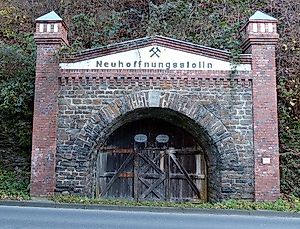
Mining also caused environmental damage. The landscape was marked by spoil heaps, the fruit trees on the Ehrlich suffered, and the slopes were bare. In the early 20th century, mining suffered from economic ups and downs. The Nazis' policy focused on armaments and self-sufficiency gave it a last flourish, but the end came in 1945, when the pumps failed as a result of the war and the mines flooded. In 1959 the processing plant was closed as well, and the spoil heaps were removed.
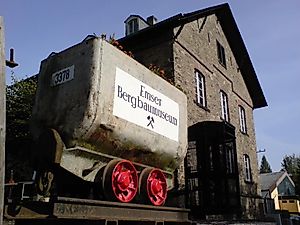
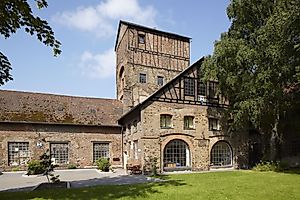
The history of mining is recalled by the Emser Bergbaumuseum (mining museum) at the Emser Hütte, which is currently being refurbished.
Pictures from the history of mining
- © Stadtarchiv
- © Stadtarchiv
- © Stadtarchiv
- © Stadtarchiv
Things to see on mining in the surrounding area
You might also like
 Photo: Dominik Ketz / RPT
 Photo: Dominik Ketz / TBEN
Good to know
Planning a stay or want to find out more about the region? Here you'll find answers to common questions about the Bad Ems-Nassau region and the Lahn Valley.
What role did mining play in the history of the Bad Ems-Nassau region?
For centuries, silver, lead and other ores were mined in the region. Mining played a major part in shaping the prosperity and development of entire towns.
What traces of mining can you still discover today?
Many places, tunnels and stories still recall the time when the foundations for the region's development were laid deep underground.
Which ores were mined in the Bad Ems-Nassau region?
Silver and lead were the main focus, although other ores were mined too.
Can you explore the traces of mining on your own?
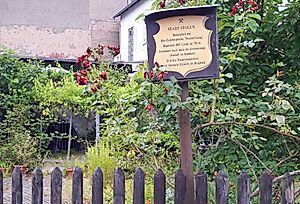
Yes, of course. There are a few relics from that time in the region, which you'll find above under Sights, for example in Bad Ems the old power station, which now houses a discount supermarket, as well as the Nieverner Hütte and the mining museum in Bad Ems.
